

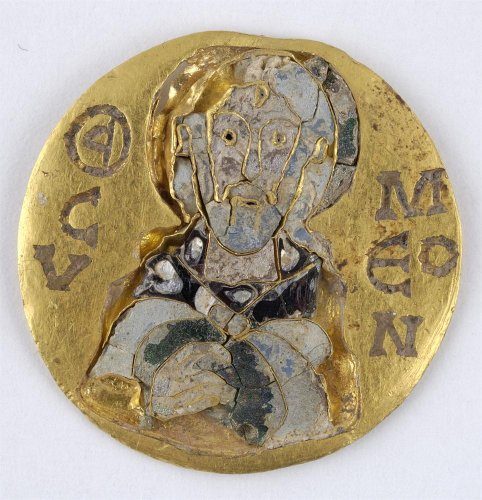
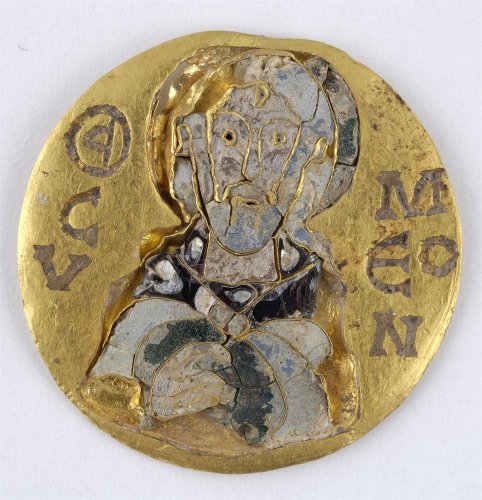
Medallion with a Bust of St Symeon; Period: Middle Byzantine; circa: 10th-11th c. Materials: gold. Dimensions: 0,021 m.
The Benaki Museum of Greek Culture is housed in one of the most beautiful neoclassical-style buildings in Athens, near the National Garden and the Hellenic Parliament. It was converted into a museum in order to shelter the collections of Antonis Benakis and was donated to the Greek nation by himself and his three sisters, Alexandra, Penelope and Argine. Following its most recent refurbishment (1989–2000), the building houses a unique exhibition on Greek culture arranged diachronically from prehistory to the 20th century.
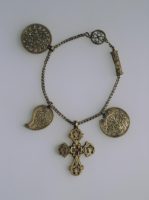
Necklace, Period: Early Byzantine, circa: 6th century. Made in Constantinople. Material: gold. Technique: carving, engraving. Dimensions: Lenght 27 cm. The collection of the State Hermitage includes over 3 million works of art and world culture artefacts. It contains paintings, graphic works, sculptures, works of applied art, archaeological artefacts and numismatic objects. The Hermitage is considered to have been founded in 1764, when Empress Catherine the Great acquired an impressive collection of works from the Berlin merchant Johann Ernst Gotzkowsky. The museum celebrates the anniversary of its founding each year on 7 December, St. Catherine’s Day. Opening Hours: Tuesday, Thursday, Saturday, Sunday: 10.30-18.00 Wednesday, Friday: 10.30-21.00 Closed: Monday.
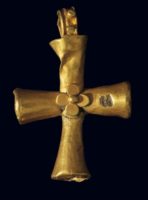
Cross, with a decorative quatrefoil rosette at the juncture of the arms. Materials: gold. Period: Early Byzantine; circa: Early 7th c. The Benaki Museum of Greek Culture is housed in one of the most beautiful neoclassical-style buildings in Athens, near the National Garden and the Hellenic Parliament.
[xyz-ihs snippet="Benaki-Hotels"]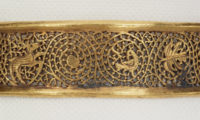
Bracelet, Period: Late Roman circa: 379 – 395 A.D. Medium: Gold. Dimensions: 1.4 × 6.3 cm (9/16 × 2 1/2 in.) Museum Description: “A simple gold band with plain flanged edges forms this openwork bracelet. A vegetal scroll weaves across the surface of the band, into which hunting scenes are inserted. On one side a hound chases a stag, while on the other a hound pursues a hare. ”
The J. Paul Getty Museum at the Getty Center in Los Angeles houses European paintings, drawings, sculpture, illuminated manuscripts, decorative arts, and photography from its beginnings to the present, gathered internationally.
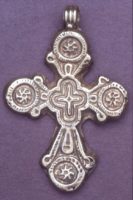
Pendant Cross, Period: Early Byzantine (7thc.) Height: 55.8 millimetres Width: 37.2 millimetres Depth: 7 millimetres Weight: 7.27 grammes. Materials: Gold. British Museum is closed 24, 25 and 26 December and 1 January, but is open every other day of the year. Fast facts about the British Museum: Founded: 1753, Collection size: 8 million objects, Oldest object in the collection: Stone chopping tool (nearly 2 million years old).
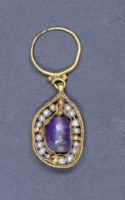
Earring; Period: Early Byzantine; circa: 6thC-7thC; Made in: Tharros. Materials: gold; with pearl and amethyst. Dimensions: Length: 35 millimetres. British Museum is closed 24, 25 and 26 December and 1 January, but is open every other day of the year. Fast facts about the British Museum: Founded: 1753, Collection size: 8 million objects, Oldest object in the collection: Stone chopping tool (nearly 2 million years old).
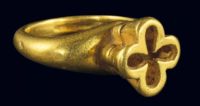
Ring with cross-shaped quatrefoil calyx bezel. Materials: gold. Period: Early Byzantine; circa: 6th-7th century. The Benaki Museum of Greek Culture is housed in one of the most beautiful neoclassical-style buildings in Athens, near the National Garden and the Hellenic Parliament.
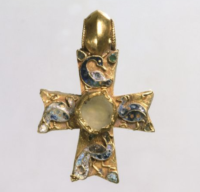
Pendant Cross with Birds and Zoe-Phos, Period: Early Byzantine, circa Late 6th Century. Materials: filigree enamel on gold. The museum is open to the public Tuesday through Sunday, 11:30 a.m.–5:30 p.m., except for federal holidays.
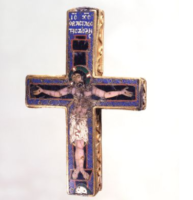
Reliquary Cross with the Crucifixion, Period: Late Byzantine, circa: Late 12th-early 13th century. Materials: enamel on gold. The museum is open to the public Tuesday through Sunday, 11:30 a.m.–5:30 p.m., except for federal holidays.
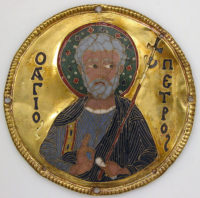
Medallion with Saint Peter from an Icon Frame, Period: Middle Byzantine, circa: ca. 1100, Made in Constantinople, Materials: Gold, silver, and enamel worked in cloisonné, Dimensions: Diam: 3 1/4in. (8.3cm) Mount: 20 1/2 x 15 x 7/8 in. (52.1 x 38.1 x 2.2 cm), On view at The Met Fifth Avenue in Gallery 303. The Metropolitan Museum of Art (New York) is one of the world’s largest and finest art museums. Its collection includes more than two million works of art spanning five thousand years of world culture, from prehistory to the present and from every part of the globe. Public Hours: 10:30 a.m.–5:30 p.m. Open seven days a week.
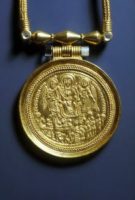
Enkolpion with Enthroned Virgin, Nativity, Adoration; and Baptism. Period: Early Byzantine Last quarter 6th century (ca. 583). Materials: gold. The museum is open to the public Tuesday through Sunday, 11:30 a.m.–5:30 p.m., except for federal holidays
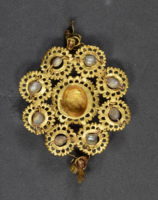
Pendant; Material: gold. Period: Late Roman; Early Byzantine; (5thc.) Found: Medinet el-Faiyum, Egypt. Open-work; composed of central setting with a stone (now missing), around which are eight small medallions, with a pearl in the middle of each. British Museum is closed 24, 25 and 26 December and 1 January, but is open every other day of the year.
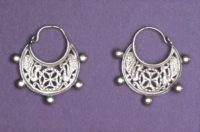
Pair of Loop Earrings; Materials: Gold. Period: Early Byzantine. 6thC-7thC. Subjects: Cross, Peacock. British Museum is closed 24, 25 and 26 December and 1 January, but is open every other day of the year. Fast facts about the British Museum: Founded: 1753, Collection size: 8 million objects, Oldest object in the collection: Stone chopping tool (nearly 2 million years old).
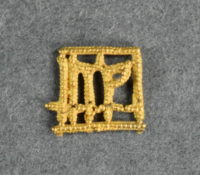
Personal gold ornament; Period: Early Byzantine Period; circa: 6thC-7thC. Length: 8 millimetres, Width: 7 millimetres. British Museum is closed 24, 25 and 26 December and 1 January, but is open every other day of the year. Fast facts about the British Museum: Founded: 1753, Collection size: 8 million objects, Oldest object in the collection: Stone chopping tool (nearly 2 million years old).
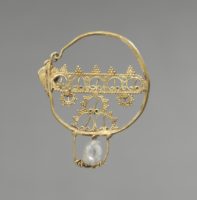
Earring with Openwork, Period: Middle Byzantine circa: 7th-9th Century. Materials: gold with a rock crystal bead. The Cleveland Art Museum Hours: Tuesdays, Thursdays, Saturdays, Sundays 10:00 a.m.–5:00 p.m. Wednesdays, Fridays 10:00 a.m.–9:00 p.m. Closed Mondays.
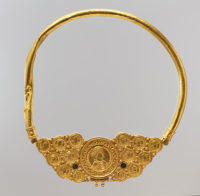
Pectoral with Coins and Pseudo-Medallion, Period: Early Byzantine, circa: 539–50, Materials: Gold, niello, On view at The Met Fifth Avenue in Gallery 302. The Metropolitan Museum of Art (New York) is one of the world’s largest and finest art museums. Its collection includes more than two million works of art spanning five thousand years of world culture, from prehistory to the present and from every part of the globe. Public Hours: 10:30 a.m.–5:30 p.m. Open seven days a week.
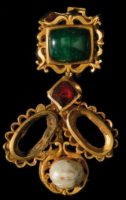
Three sections of a Gold necklace. Materials: sapphires, emeralds, cornelians and pearls. Period: Early Byzantine; circa: 5th c. Made in: Alexandria, Egypt. Their height varies from 0.05 to 0.06 m. The Benaki Museum of Greek Culture is housed in one of the most beautiful neoclassical-style buildings in Athens, near the National Garden and the Hellenic Parliament.
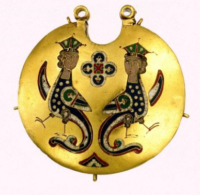
Pair of Kolti with Sirens, Period: Middle Byzantine Period, ca. 843-1204 AD. Late 11th-12th Century. The museum is open to the public Tuesday through Sunday, 11:30 a.m.–5:30 p.m., except for federal holidays.
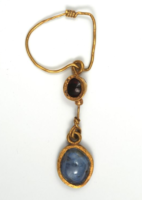
Earring, Materials: Ruby, Sapphire, Gold and Gems. Period: Early Byzantine, early 5th century. Found in 1910 during restoration work in Piazza della Consolazione, Rome. The museum is open to the public Tuesday through Sunday, 11:30 a.m.–5:30 p.m., except for federal holidays.
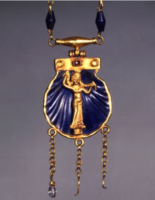
Necklace with Pendant of Aphrodite Anadyomene, Period: Early Byzantine, circa early 7th Century. The museum is open to the public Tuesday through Sunday, 11:30 a.m.–5:30 p.m., except for federal holidays.
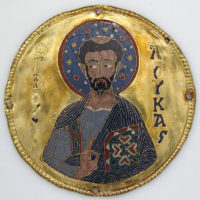
Medallion with Saint Luke from an Icon Frame, Period: Middle Byzantine, circa: ca. 1100, Made in Constantinople, Materials: Gold, silver, and enamel worked in cloisonné, Dimensions: Diam: 3 1/4 in. (8.3 cm) Mount: 20 1/2 x 15 x 7/8 in. (52.1 x 38.1 x 2.2 cm), On view at The Met Fifth Avenue in Gallery 303. The Metropolitan Museum of Art (New York) is one of the world’s largest and finest art museums. Its collection includes more than two million works of art spanning five thousand years of world culture, from prehistory to the present and from every part of the globe. Public Hours: 10:30 a.m.–5:30 p.m. Open seven days a week.
No entries were found.