


Pendant Cross, Material: Gold. Period: Early Byzantine, circa: 500s.
The Cleveland Art Museum Hours: Tuesdays, Thursdays, Saturdays, Sundays 10:00 a.m.–5:00 p.m. Wednesdays, Fridays 10:00 a.m.–9:00 p.m. Closed Mondays.


Quantity of pearl, tourmaline, glass, coral and bronze beads, once attached no doubt to cloth. Period: Early Byzantine circa: 6-7th century. Made in/Findspot: Constantinople. In the Istanbul Archaeological Museum collections, there are rich and very important works of art belonging to various civilizations from the regions from Africa to Balkans , from Anatolia and Mesopotamia to Arab Peninsula and Afghanistan that were in the borders of the Ottoman Empire.
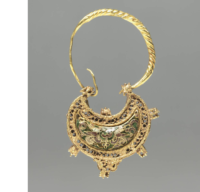
Crescent-Shaped Earring, Materials: Gold filigree with cloisonné enamel. Period: Middle Byzantine circa: 1000-1100. Dimensions: 2.3 x 2.6 cm (7/8 x 1 in.). The Cleveland Art Museum Hours: Tuesdays, Thursdays, Saturdays, Sundays 10:00 a.m.–5:00 p.m. Wednesdays, Fridays 10:00 a.m.–9:00 p.m. Closed Mondays.
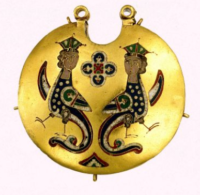
Pair of Kolti with Sirens, Period: Middle Byzantine Period, ca. 843-1204 AD. Late 11th-12th Century. The museum is open to the public Tuesday through Sunday, 11:30 a.m.–5:30 p.m., except for federal holidays.
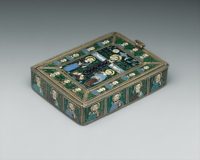
The Fieschi Morgan Staurotheke, Period: Middle Byzantine, circa: early 9th century, Made in Constantinople, Materials: Gilded silver, gold, enamel worked in cloisonné, and niello. On view at The Met Fifth Avenue in Gallery 303. The Metropolitan Museum of Art (New York) is one of the world’s largest and finest art museums. Its collection includes more than two million works of art spanning five thousand years of world culture, from prehistory to the present and from every part of the globe. Public Hours: 10:30 a.m.–5:30 p.m. Open seven days a week.

This medallion of Christ is from a group of twelve that once surrounded an icon of the archangel Gabriel. Period: Middle Byzantine, circa: ca. 1100, Made in Constantinople, Materials: Gold, silver, and enamel worked in cloisonné. The Metropolitan Museum of Art (New York) is one of the world’s largest and finest art museums. Its collection includes more than two million works of art spanning five thousand years of world culture, from prehistory to the present and from every part of the globe. Public Hours: 10:30 a.m.–5:30 p.m. Open seven days a week.
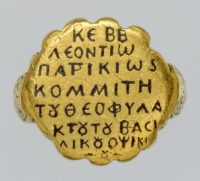
Ring of Leontios, Period: Middle Byzantine, circa: 1000, Materials: Gold, niello, Inscribed: “Lord help Leontius, Patrician and Count of imperial Obsikion guarded by God”. The ring came from Leontios of the district of Opsikion, in exactly what is currently northwestern Turkey. Patrikios as well as komes were Roman titles that moved in definition throughout the Byzantine period; it promises that Leontios was the guv of the district or an upper-level general. On view at The Met Fifth Avenue in Gallery 303 . The Metropolitan Museum of Art (New York) is one of the world’s largest and finest art museums. Its collection includes more than two million works of art spanning five thousand years of world culture, from prehistory to the present and from every part of the globe. Public Hours: 10:30 a.m.–5:30 p.m. Open seven days a week.
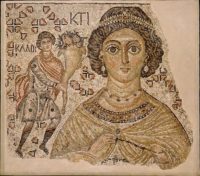
Fragment of a Floor Mosaic with a Personification of Ktisis, Period: Early Byzantine circa: 500–550, with modern restoration. Materials: Marble and glass. The Metropolitan Museum of Art (New York) is one of the world’s largest and finest art museums. Its collection includes more than two million works of art spanning five thousand years of world culture, from prehistory to the present and from every part of the globe. Public Hours: 10:30 a.m.–5:30 p.m. Open seven days a week.

Mosaic Panel. Period: Early Byzantine; circa: Late 6th – early 7th century. Findspot: Istanbul, Kalenderhane Mosque excavations. Decorated the southern niche of the apse; it depicts the earliest presentation scene, the hypapante, found in Istanbul. Materials: stone, glass. In the Istanbul Archaeological Museum collections, there are rich and very important works of art belonging to various civilizations from the regions from Africa to Balkans , from Anatolia and Mesopotamia to Arab Peninsula and Afghanistan that were in the borders of the Ottoman Empire.

Solidus of Justinian I, Period: Early Byzantine, circa: 552–565 A.D. Minted in: Ravenna, Material: Gold. The Museum of Fine Arts, Boston is open 7 days a week. Monday and Tuesday 10 am–5 pm, Wednesday–Friday 10 am–10 pm, Saturday and Sunday 10 am–5 pm.

Pendant depicting the scene “Triumphal Entry” . Period: Early Byzantine; circa: 5-6th century. Material: glass. In the Istanbul Archaeological Museum collections, there are rich and very important works of art belonging to various civilizations from the regions from Africa to Balkans , from Anatolia and Mesopotamia to Arab Peninsula and Afghanistan that were in the borders of the Ottoman Empire.
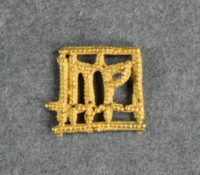
Personal gold ornament; Period: Early Byzantine Period; circa: 6thC-7thC. Length: 8 millimetres, Width: 7 millimetres. British Museum is closed 24, 25 and 26 December and 1 January, but is open every other day of the year. Fast facts about the British Museum: Founded: 1753, Collection size: 8 million objects, Oldest object in the collection: Stone chopping tool (nearly 2 million years old).

Paten with Cross and Inscription, Period: Early Byzantine, circa: Mid 6th Century. Materials: silver, gilding and niello. The museum is open to the public Tuesday through Sunday, 11:30 a.m.–5:30 p.m., except for federal holidays.

Benediction Cross, Period: Late Byzantine, circa: 1200s-1400s. Materials: black schist, gold, silver. The Cleveland Art Museum Hours: Tuesdays, Thursdays, Saturdays, Sundays 10:00 a.m.–5:00 p.m. Wednesdays, Fridays 10:00 a.m.–9:00 p.m. Closed Mondays.

Cross, Period: Early Byzantine, circa: 6th c. Made in: Constantinople. Material: gold. Dimensions: 5х3 cm. The collection of the State Hermitage includes over 3 million works of art and world culture artefacts. It contains paintings, graphic works, sculptures, works of applied art, archaeological artefacts and numismatic objects. The Hermitage is considered to have been founded in 1764, when Empress Catherine the Great acquired an impressive collection of works from the Berlin merchant Johann Ernst Gotzkowsky. The museum celebrates the anniversary of its founding each year on 7 December, St. Catherine’s Day. Opening Hours: Tuesday, Thursday, Saturday, Sunday: 10.30-18.00 Wednesday, Friday: 10.30-21.00 Closed: Monday.
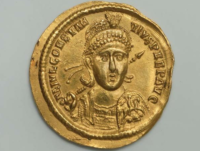
Solidus of Constantius II (333–361). Material: Gold. The museum is open to the public Tuesday through Sunday, 11:30 a.m.–5:30 p.m., except for federal holidays.

Octagonal intaglio, Period: Late Byzantine; circa: 14thc. Made in: Constantinople. Dimensions: Height: 1.7 centimetre. Material: sard. British Museum is closed 24, 25 and 26 December and 1 January, but is open every other day of the year. Fast facts about the British Museum: Founded: 1753, Collection size: 8 million objects, Oldest object in the collection: Stone chopping tool (nearly 2 million years old).
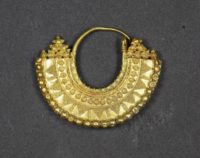
Gold Earring; semi-circular; with U-shaped loop to which is attached a similarly shaped thin plate of gold. Period: Middle Byzantine; 11thc.-12thc.; Found/Acquired: Syria. British Museum is closed 24, 25 and 26 December and 1 January, but is open every other day of the year.
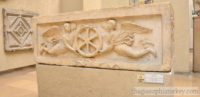
Sarcophagus – from the imperial cemetery beside the Church of the Holy Apostles. Period: Early Byzantine; circa: early 5th century. Material: Marble, Findspot: Sariguzel/Fatih – Istanbul.
In the Istanbul Archaeological Museum collections, there are rich and very important works of art belonging to various civilizations from the regions from Africa to Balkans , from Anatolia and Mesopotamia to Arab Peninsula and Afghanistan that were in the borders of the Ottoman Empire.

Leaf of the Consular Diptych of Areobindus, Period: Early Byzantine, Date: 506, School: Constantinople, Material: ivory, Technique: carved, Dimensions: 37,6; 14 cm. The collection of the State Hermitage includes over 3 million works of art and world culture artefacts. It contains paintings, graphic works, sculptures, works of applied art, archaeological artefacts and numismatic objects. The Hermitage is considered to have been founded in 1764, when Empress Catherine the Great acquired an impressive collection of works from the Berlin merchant Johann Ernst Gotzkowsky. The museum celebrates the anniversary of its founding each year on 7 December, St. Catherine’s Day. Opening Hours: Tuesday, Thursday, Saturday, Sunday: 10.30-18.00 Wednesday, Friday: 10.30-21.00 Closed: Monday.

Copper Alloy Weight, Period: Early Byzantine, 6thc-7thc, discoidal with double-grooved convex profile; lathe-turned with rims; face engraved with double wreath enclosing cross above denominational mark, both inlaid with silver. British Museum is closed 24, 25 and 26 December and 1 January, but is open every other day of the year.
No entries were found.