


Sapphire and Tourmaline Ring Gems; Period: Early Byzantine, circa: 6-7th century. Findspot/Location: Constantinople. Materials: Sapphire, Tourmaline. In the Istanbul Archaeological Museum collections, there are rich and very important works of art belonging to various civilizations from the regions from Africa to Balkans , from Anatolia and Mesopotamia to Arab Peninsula and Afghanistan that were in the borders of the Ottoman Empire.


Solidus of Constans II, Period: Early Byzantine, circa: 651–654. Minted in: Constantinople. Material: Gold. The Museum of Fine Arts, Boston is open 7 days a week. Monday and Tuesday 10 am–5 pm, Wednesday–Friday 10 am–10 pm, Saturday and Sunday 10 am–5 pm.
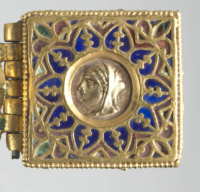
Buckle with Embossed Head in Profile, Period: Early Byzantine, circa: 400-600. Materials: gold, lapis lazuli, and glass. The Cleveland Art Museum Hours: Tuesdays, Thursdays, Saturdays, Sundays 10:00 a.m.–5:00 p.m. Wednesdays, Fridays 10:00 a.m.–9:00 p.m. Closed Mondays.

Polycandelon in the form of a pierced disk with openwork cross and nine circular perforations; Period: Early Byzantine, circa: 6thc.-7thc. Materials: copper alloy. Dimensions: Diameter: 279 millimetresHeight: 757 millimetres (suspended)Weight: 1.626 kilograms. British Museum is closed 24, 25 and 26 December and 1 January, but is open every other day of the year. Fast facts about the British Museum: Founded: 1753, Collection size: 8 million objects, Oldest object in the collection: Stone chopping tool (nearly 2 million years old).

Necklace; Cross pendant; Period: Early Byzantine; 5thc.-6thc.; Materials: glass, amber, amethyst and carnelian beads. Found: Qaw el-Kebir, Egypt, Upper Egypt. British Museum is closed 24, 25 and 26 December and 1 January, but is open every other day of the year.
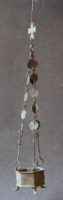
Censer; Period: Early Byzantine; circa: 6thc.-7thc.; Found: Syria. Materials: copper alloy. Dimensions: Diameter: 79 millimetresLength: 475 millimetres (suspension unit)Height: 61 millimetres. British Museum is closed 24, 25 and 26 December and 1 January, but is open every other day of the year. Fast facts about the British Museum: Founded: 1753, Collection size: 8 million objects, Oldest object in the collection: Stone chopping tool (nearly 2 million years old).

Fragment of a Tunic, Period: Early Byzantine; circa: 5th – 7th century; Materials: tapestry weave; wool and linen. The Cleveland Art Museum Hours: Tuesdays, Thursdays, Saturdays, Sundays 10:00 a.m.–5:00 p.m. Wednesdays, Fridays 10:00 a.m.–9:00 p.m. Closed Mondays.

Quantity of pearl, tourmaline, glass, coral and bronze beads, once attached no doubt to cloth. Period: Early Byzantine circa: 6-7th century. Made in/Findspot: Constantinople. In the Istanbul Archaeological Museum collections, there are rich and very important works of art belonging to various civilizations from the regions from Africa to Balkans , from Anatolia and Mesopotamia to Arab Peninsula and Afghanistan that were in the borders of the Ottoman Empire.
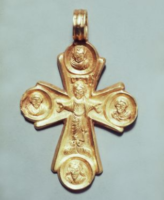
Enkolpion with Crucifixion, Busts of the Virgin, St. John and Two Saints. Period: Early Byzantine, circa: 6th-7th century. The museum is open to the public Tuesday through Sunday, 11:30 a.m.–5:30 p.m., except for federal holidays.
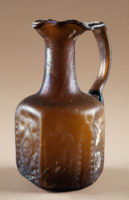
Hexagonal jug with Christian symbols, Material: Glass, mold-blown. Place of Manufacture: Jerusalem. Period: Early Byzantine circa: Late 6th–early 7th century A.D. Dimensions: Height: 13.2 cm (5 3/16 in.).The MFA is open 7 days a week. Monday and Tuesday 10 am–5 pm, Wednesday–Friday 10 am–10 pm, Saturday and Sunday 10 am–5 pm.

Spherical Small Container (pyxis) with Representations of Christ, Virgin and two Archangels. Period: Early Byzantine, circa: 6th–7th century A.D. Dimensions: Height x diameter: 7 x 9 cm (2 3/4 x 3 9/16 in.). Materials: Silver with gilding. This gilded silver pyxis of round kind was a container for antiques or scent made use of in Early Byzantine church ceremonies. The 4 figures created in repousse method reveal a bearded Christ offering a true blessing, the Virgin holding a symbol symbolic of her duties as Mother of God (Theotokos), as well as 2 angels worn lengthy sleeved chitons with segmenta on their shoulders and also hems. The cover is shed however could have had a dedicatory inscription.
The MFA is open 7 days a week. Monday and Tuesday 10 am–5 pm, Wednesday–Friday 10 am–10 pm, Saturday and Sunday 10 am–5 pm.
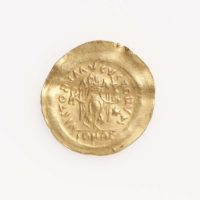
Tremissis of Justinian I, Period: Early Byzantine Period, circa: 552–565 A.D. , Minted in: Ravenna, Material: Gold. The Museum of Fine Arts, Boston is open 7 days a week. Monday and Tuesday 10 am–5 pm, Wednesday–Friday 10 am–10 pm, Saturday and Sunday 10 am–5 pm.
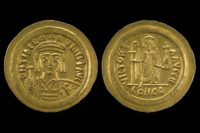
Gold Coin, Ruler: Maurice Tiberius; Period: Early Byzantine; circa: 582-602; Minted in: Ravenna. British Museum is closed 24, 25 and 26 December and 1 January, but is open every other day of the year. Fast facts about the British Museum: Founded: 1753, Collection size: 8 million objects, Oldest object in the collection: Stone chopping tool (nearly 2 million years old).

Plate with David Slaying a Lion, Period: Early Byzantine, circa: 629–630, Materials: Silver, Made in Constantinople, The Metropolitan Museum of Art (New York) is one of the world’s largest and finest art museums. Its collection includes more than two million works of art spanning five thousand years of world culture, from prehistory to the present and from every part of the globe. Public Hours: 10:30 a.m.–5:30 p.m. Open seven days a week.
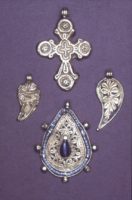
Pendant; material: gold; hollow box building; in the form of a bent leaf; obverse chased and convex marked, butt-soldered to a simple opposite; suspension loophole of triple-ribbed strip, the angle in between the loophole and the obverse masked by a brief length of the very same strip. Height: 32.2 millimetres Width: 15.5 millimetres. Period: Early Byzantine. British Museum is closed 24, 25 and 26 December and 1 January, but is open every other day of the year. Fast facts about the British Museum: Founded: 1753, Collection size: 8 million objects, Oldest object in the collection: Stone chopping tool (nearly 2 million years old).
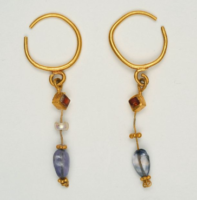
Pair of Earrings. Materials: Pearls, Sapphires, Gold, Gems and Gold Globules. Period: Early Byzantine, circa: Early 5th Century. The museum is open to the public Tuesday through Sunday, 11:30 a.m.–5:30 p.m., except for federal holidays.

Bronze Signet Ring, Period: Early Byzantine, high circular bezel rudely engraved in intaglio with standing figure. Findspot: Smyrna, Anatolia. (Modern: Izmir, Turkey) British Museum is closed 24, 25 and 26 December and 1 January, but is open every other day of the year. Fast facts about the British Museum: Founded: 1753, Collection size: 8 million objects, Oldest object in the collection: Stone chopping tool (nearly 2 million years old).
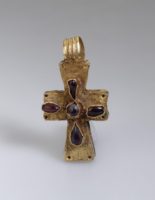
Cross, Period: Early Byzantine, circa: 5th-6th century, Materials: golad and garnet. Dimensions: 3,8×1,9 cm. The collection of the State Hermitage includes over 3 million works of art and world culture artefacts. It contains paintings, graphic works, sculptures, works of applied art, archaeological artefacts and numismatic objects. The Hermitage is considered to have been founded in 1764, when Empress Catherine the Great acquired an impressive collection of works from the Berlin merchant Johann Ernst Gotzkowsky. The museum celebrates the anniversary of its founding each year on 7 December, St. Catherine’s Day. Opening Hours: Tuesday, Thursday, Saturday, Sunday: 10.30-18.00 Wednesday, Friday: 10.30-21.00 Closed: Monday.

Bowl with Hunting Scene, Period: Early Byzantine, 5th Century A.D. Material: silver. The museum is open to the public Tuesday through Sunday, 11:30 a.m.–5:30 p.m., except for federal holidays.

Bird Figure, Period: Early Byzantine, circa: 6thC-7thC; Made in: Egypt. Dimensions: Height: 2.6 inches. British Museum is closed 24, 25 and 26 December and 1 January, but is open every other day of the year. Fast facts about the British Museum: Founded: 1753, Collection size: 8 million objects, Oldest object in the collection: Stone chopping tool (nearly 2 million years old).
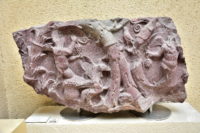
Sarcophagus Fragment of Emperor Constantine the Great (?) Materials: Porphyry Period: Early Byzantine circa: 4th century. In the Istanbul Archaeological Museum collections, there are rich and very important works of art belonging to various civilizations from the regions from Africa to Balkans , from Anatolia and Mesopotamia to Arab Peninsula and Afghanistan that were in the borders of the Ottoman Empire.
No entries were found.